Wednesday, March 30, 2022

Michigan Group Launches Petition Drive For Psychedelic Legalization

An activist group based in Michigan has received the go-ahead from state election officials to start gathering signatures for a psychedelic legalization initiative to make it onto this year’s ballot.

The group, known as Decriminalize Nature Michigan, said on Monday that the state’s Board of Canvassers “certified that the Michigan Initiative for Community Healing could begin collecting the required 340,047 signatures needed by June 1st to qualify for the November ballot.”

According to a press release from the group, the initiative “would decriminalize the possession and cultivation of ‘Natural plants and mushrooms’, reduce penalties for controlled substances that currently include life sentences and lifetime probation, and create pathways for religious organizations and hospitals to develop psychedelic assisted mental health and ceremonial services.”

Julie Barron, co-director of Decrim Nature Michigan, said in the press release that psychedelic assisted therapy offers a “rare ray of hope for people who have been suffering.”

Along with both the national and Michigan-based chapters of Decriminalize Nature, the coalition behind the initiative also includes People for Healthy Choices Michigan (PFHC) and Students for Sensible Drug Policy (SSDP).

“Young people across the country have been calling on our elected officials for safe and sensible drug policies to be implemented for decades,” said Kat Ebert, an SSDP board member. “This is an opportunity for the people of Michigan to make history by coming together to pass policy that’s centered around compassion instead of criminalization.”

The activists submitted the proposed initiative to Michigan ballot officials last month. If the initiative were to be ultimately approved by voters in November, it “would decriminalize personal use, possession and growth of psychoactive substances for adults 18 and reduce penalties for all controlled substance use and possession in Michigan,” while also permitting “religious organizations and entities designated by hospitals certified by the state health department to produce and sell entheogenic plants,” according to MLive.com.

Myc Williams, the other co-director of Decriminalize Nature Michigan, said at the time that initiative amounts to “true decriminalization.”

The initiative also includes a host of other drug reforms, including the removal of test equipment from what the state defines as “drug paraphernalia.”

Williams said that people in Michigan “who choose to use drugs can be charged with another crime to test their substance.”

“In a time of heavy fentanyl overdoses, it’s really important for people who do use drugs to know what they’re consuming regardless of their legality from a public safety perspective,” Williams said then. “The state supports harm reduction in the distribution of Narcan and fentanyl strips, which fentanyl strips are technically illegal. There’s a contradiction there and we’re just clearing it up.”

After a decade in which dozens of states and cities ended their prohibition on recreational pot use, psychedelics are emerging as the new frontier in the legalization movement, with lawmakers and policymakers increasingly open to their potential therapeutic value.

This month in Connecticut, lawmakers pushed forward a bill that would devote $3 million for psychedelic-assisted therapy research in the state.

Although it would not legalize psychedelics, it would establish a program through which qualifying patients could receive MDMA-assisted or psilocybin-assisted therapy from the state Department of Mental Health and Addiction Services.

The legislation would also establish a regulatory panel that would offer recommendations regarding the “design and development of the regulations and infrastructure necessary to safely allow for therapeutic access to psychedelic-assisted therapy upon the legalization of MDMA, psilocybin and any other psychedelic compounds.”

The post Michigan Group Launches Petition Drive For Psychedelic Legalization appeared first on High Times.


source https://hightimes.com/news/michigan-group-launches-petition-drive-for-psychedelic-legalization/?utm_source=rss&utm_medium=rss&utm_campaign=michigan-group-launches-petition-drive-for-psychedelic-legalization

Tuesday, March 29, 2022

Louisiana Mulls Locking Up Kids For Weed Again

Lawmakers in Louisiana are considering a bill that could put minors behind bars for possessing even small amounts of pot, less than a year after the state enacted legislation to end jail time for low-level cannabis possession convictions. The measure, House Bill 700, was introduced in the Louisiana House of Representatives by Republican state Representative Larry Bagley on March 4 and approved by a legislative committee last week.

Last year, the Louisiana legislature passed House Bill 652, a bill to decriminalize possession of small amounts of cannabis. The bill was passed in June and went into effect in August, ending the possibility of jail time for possessing less than 14 grams of weed. The legislation was hailed by cannabis reform advocates including Peter Robins-Brown, policy and advocacy director at Louisiana Progress, a partnership between the Coalition for Louisiana Progress and Louisiana Progress Action Fund.

“Marijuana decriminalization will truly make a difference in the lives of the people of our state,” Robins-Brown said after the decriminalization bill was passed last year. “It’s an important first step in modernizing marijuana policy in Louisiana, and it’s another milestone in the ongoing effort to address our incarceration crisis, which has trapped so many people in a cycle of poverty and prison. Now it’s time to make sure that everyone knows their rights under this new law, and that law enforcement officers understand how to properly implement it.”

But now some of that progress is in jeopardy from Bagley’s bill, which would once again put jail time on the table for minors caught possessing small amounts of cannabis. The legislation would amend Louisiana’s decriminalization bill to resurrect jail time as a possible sentence for weed possession by young people, but would not affect the penalties imposed on adults convicted of the same offense.

Hard Labor for Half a Lid

Under HB 700, people under 18 caught with less than 14 grams of cannabis can be placed on probation or “imprisoned for not more than fifteen days” on the first conviction, according to the text of the legislation. For cases involving amounts of cannabis greater than 14 grams, a first conviction can put a kid behind bars for up to six months.

The penalties become more severe upon subsequent convictions. A minor’s second conviction for possessing up to 14 grams of cannabis can result in six months in jail. A third and fourth conviction subjects children to sentences of two and four years imprisonment, respectively, “with or without hard labor,” for possessing less than a half-ounce of weed.

Bagley has said that HB 700 is needed because schools in the state are having trouble keeping cannabis off of school grounds, according to the Louisiana Illuminator. He said that prosecutors have no way to force children into drug rehabilitation programs without the threat of incarceration and that judges are unlikely to incarcerate a minor for possession of small amounts of pot.

“It was presented like this bill is about trying to put people in prison. It’s not,” Bagley said.

But Robins-Brown, who is now the executive director of Louisiana Progress, said that school disciplinary action including suspension, expulsion or exclusion from athletics and other activities is a more appropriate way to address the problem.

“We don’t think we should be criminalizing youth more harshly than adults,” Robins-Brown said.

Megan Garvey with the Louisiana Association for Criminal Defense Lawyers noted that other options exist to compel minors into drug treatment. Under state law, family court judges can mandate parents or guardians place their children in treatment programs.

But the bill is receiving bipartisan support from lawmakers. State Representative Nicholas Muscarello voted in favor of HB 700 in committee despite generally supporting laws relaxing cannabis prohibition.

“We are trying to rehabilitate children. This allows our courts to kind of keep them in check and put them in drug courts,” said Muscarello. “No judge is putting a kid in jail for six months for marijuana.”

Although he also voted for the bill in committee, Republican state Representative Danny McCormick expressed concerns about HB 700’s revival of jail time for kids caught with weed. He questioned why the penalties were more severe than laws prohibiting possession of alcohol or tobacco by young people. Under Louisiana law, people under 21 can be fined up to $100 and lose their driver’s license for up to six months for possessing alcohol, while minors possessing cigarettes can be fined $50.

“Alcohol, in my opinion, would be greatly more harmful than marijuana,” McCormick said.

Last week, the House Committee on the Administration of Criminal Justice approved HB 700 after amending the measure to include exceptions for minors who are registered medical cannabis patients possessing regulated cannabis products. On Monday, the bill was scheduled for a floor debate by the full Lousiana House of Representatives to be held on April 5.

The post Louisiana Mulls Locking Up Kids For Weed Again appeared first on High Times.


source https://hightimes.com/news/louisiana-mulls-locking-up-kids-for-weed-again/?utm_source=rss&utm_medium=rss&utm_campaign=louisiana-mulls-locking-up-kids-for-weed-again

Most NYers Oppose Giving First Dispensary Licenses To Those With Pot Convictions

New York unveiled a pioneering new plan earlier this month as it prepares to launch its new adult-use cannabis program later this year, with the first round of retail licenses reserved for individuals previously convicted of a pot-related charge, or who have relatives with a cannabis conviction.

But while many social justice advocates applauded the measure, a majority of the state’s voters are not on board.

A poll out this week from Siena College found that 54 percent of voters in the Empire State “oppose ensuring that early licenses for marijuana retail stores go to those previously convicted of marijuana-related crimes, or their family members.” Only 33 percent are in favor of the proposal.

The opposition is most pronounced among New York Republicans, 72 percent of whom told the pollsters that they are against the idea. Only 19 percent of Republicans said they back it.

Among Democrats, the proposal produced a near-even split: 45 percent said they support the idea, while 43 percent oppose. A majority of New York state independents, 55 percent, also said they are against the proposal.

“Giving first dibs on marijuana licenses to those previously convicted divides Democrats and New York City voters. Strong majorities of Republicans, independents, voters outside New York City, and white voters give it a thumbs down,” Siena College pollster Steven Greenberg said in the survey’s analysis. “Latino voters support it by 12 points and Black voters by 11 points.”

New York Gov. Kathy Hochul, a Democrat, announced the “the first-in-the-nation Seeding Opportunity Initiative” earlier this month, which her office said would ensure “an early investment into communities most impacted by the disproportionate enforcement of cannabis prohibition.”

Under the initiative, the first 100-200 licenses for adult-use pot dispensaries would be awarded to either an individual previously convicted of a weed-related offense, or a parent, guardian, child, spouse or dependent of an individual with a pot conviction.

“New York State is making history, launching a first-of-its-kind approach to the cannabis industry that takes a major step forward in righting the wrongs of the past,” Hochul said in a statement at the time. “The regulations advanced by the Cannabis Control Board today will prioritize local farmers and entrepreneurs, creating jobs and opportunity for communities that have been left out and left behind. I’m proud New York will be a national model for the safe, equitable and inclusive industry we are now building.”

In the announcement earlier this month, Hochul’s office said the initiative would be comprised of three different programs: the Equity Owners Lead Program, which will provide “a Conditional Adult-Use Retail Dispensary License to eligible equity-entrepreneur applicants, putting them at the front-end of the adult-use market”; the Farmers First Program, which provides “an Adult-Use Conditional Cultivator License to eligible New York cannabinoid hemp farmers, giving them the first chance to grow cannabis for New York’s adult-use market”; and the New York Social Equity Cannabis Investment Program, a $200 million program proposed in Hochul’s budget that would “make funding available for equity entrepreneurs at the forefront of the adult-use cannabis market.”

Hochul, who took over as New York governor following the resignation of Andrew Cuomo in August, has made it a priority to jumpstart the state’s recreational cannabis program. In September, she completed appointments to the state’s Office of Cannabis Management shortly after taking office.

The state expects recreational pot sales to begin by the end of the year, and all signs are pointing to a lucrative industry. According to a budget projection from Hochul’s office in January, New York expects to collect $1.25 billion in tax revenue from recreational pot sales over the next six years.

The post Most NYers Oppose Giving First Dispensary Licenses To Those With Pot Convictions appeared first on High Times.


source https://hightimes.com/news/most-nyers-oppose-giving-first-dispensary-licenses-to-those-with-pot-convictions/?utm_source=rss&utm_medium=rss&utm_campaign=most-nyers-oppose-giving-first-dispensary-licenses-to-those-with-pot-convictions

Cannabis Consumption Lounge To Transform Detroit, Michigan Neighborhood

According to a press release, a new business called Hot Box Social announced that it is the first licensed consumption lounge to open doors in Michigan, while other businesses in the state have laid similar claims. Michigan is now the seventh state in the U.S. to allow consumption lounges, but the way the businesses are regulated varies.

The consumption lounge will open in Detroit, Michigan’s Hazel Park neighborhood, between 9 Mile and 10 Mile roads. Hot Box Social is owned by Troy, Michigan-based Trucenta, which also operates the award-winning Breeze adult-use provisioning center in Hazel Park as well.

Cannabis products consumed at Hot Box Social, however, are required to be delivered by a licensed provisioning center (i.e. dispensary). But the lounge will provide advisors on-site to help guide guests during consumption. 

Hot Box Social will open later this month for private events. The venue is located at 23610 John R Rd in Main Street Hazel Park. The team behind Hot Box Social plans to create a relaxed gathering space for meetings and special events where cannabis can be consumed in a safe and supportive environment. 

“It’s an exciting time,” Nowfal Akash, Trucenta Chief Information Officer, told High Times. “When it comes to marijuana, you can either take a wait-and-see approach or you can lead, and Trucenta and Hot Box Social are happy to be number one as the state’s first licensed consumption lounge. We’re beginning with private and ticketed events and will open to the general public later this Summer.”

For now, capacity is limited to approximately 200 people for private indoor events, in its 3,000 square feet lounge. The team plans to open a 5,000 square feet back patio later in the summer as well.

“We are honored that Michigan has awarded us the state’s first license for a consumption lounge,” Akash said in a statement. “Our plan is to first use the space for corporate, social and special events. Come summer, we’ll start scheduling events so the public can experience Hot Box Social with consumption-friendly activities like social gatherings, educational opportunities, and arts-focused activities.” 

Michigan’s Marijuana Regulatory Agency began accepting applications for all adult-use licenses, including for consumption spaces, on November 1, 2019. A few other businesses are trying to do the same. Liberty Ann Arbor cannabis provisioning center in Ann Arbor also set out to become the first consumption lounge in Michigan after gaining one of the first licenses. Ann Arbor, for instance, plans on issuing 28 licenses for that type of business model. Detroit listed 35 available licenses for consumption establishments last year. Vehicle City Social is another similar business.

The lounge has been two years in the making, complete with sliding glass doors that can air out a smokey room quickly, Detroit News reports.

“Our hope is that Hot Box Social will be used to bring a new experience for companies hosting brainstorming meetings, friends who are gathering for private parties, and one-of-a-kind fundraisers to raise money for nonprofit organizations,” Akash added.

The amount of doses that patrons can receive will start out small, almost a microdose, but probably grow to a larger initial dose.

“The FDA has a certain recommendation about 5mg as an initial dose. We want to cut that in half and probably float around the 2-2.5mg range for a first-timer just to be safe,” Akash said, according to a WXYZ Detroit report.

Currently, the team behind Hot Box Social doesn’t know if they will be charging patrons for the space usage, but for now, they will be opening up a kitchen that will offer food.

The post Cannabis Consumption Lounge To Transform Detroit, Michigan Neighborhood appeared first on High Times.


source https://hightimes.com/news/cannabis-consumption-lounge-to-transform-detroit-michigan-neighborhood/?utm_source=rss&utm_medium=rss&utm_campaign=cannabis-consumption-lounge-to-transform-detroit-michigan-neighborhood

New Jersey Regulators Delay Launch of Recreational Pot Sales

New Jersey regulators last week declined to award retail cannabis licenses to eight medical dispensaries seeking to sell adult-use cannabis, delaying the expected launch of recreational pot sales in the state for at least weeks. The delay, which reportedly surprised cannabis industry insiders, came less than a month after New Jersey Gov. Phil Murphy said that recreational sales were expected to begin “within weeks.”

At a meeting of the state’s Cannabis Regulatory Commission (CRC) on Thursday, executive director Jeff Brown said that the agency wants the eight alternative treatment centers (ATCs), as medical cannabis dispensaries are called in New Jersey, to submit plans specifying how the businesses will ensure there is enough cannabis for patients when recreational sales begin.

“We may not be 100% there today, but I assure you we will get there,” Brown said on March 24, as quoted by NJ.com. “We have a few things to address and when we address them I’m happy to return to this body with a further update.”

The commission then voted 5-0 to table the recreational sales licenses for the eight businesses until a later date.

Ensuring a Supply of Cannabis for New Jersey Patients

Brown said that the commission is concerned that the dispensaries will not have enough cannabis for medical patients, estimating that the market could be short up to 100,000 pounds of cannabis to meet the needs of both recreational customers and patients. Brown added that the CRC would conduct site visits to the applicants to make sure that they will be able to handle the new influx of customers, noting the commission wanted the businesses to have separate entrances and service lines for patients and recreational customers.

“Our goal is to work with the industry and the industry to work with us so at the very next CRC meeting we have a cohort of ATCs that are turn-key to launch this market here, simply pending a vote by this commission,” Brown said. “If for any that are still not there, hopefully [they’ll be] ready for conditional approval pending certain timelines and regulatory milestones that we can work to get done.”

Senate President Nicholas Scutari, who led the drive to legalize medical and recreational cannabis in the New Jersey legislature, expressed frustration after the CRC announced the delay.

“Totally unacceptable,” Scutari wrote in a text message to NJ Advance Media. “The Senate is weighing its options with regard to oversight.”

Representatives of the state’s cannabis industry were also displeased by the setback. The New Jersey Cannabis Trade Association said in a statement that it “remains optimistic that the CRC will sooner rather than later open the adult-use cannabis market in New Jersey, though we admit to being disappointed with today’s decision to further continue its delay.”

“In November 2020, New Jerseyans made it very clear that they wanted a safe and legal adult-use cannabis marketplace in the state,” the trade group added. “It goes without saying that no one could have foreseen that some 16 months later, we would still be waiting to see this come to fruition.”

The CRC did, however, approve conditional licenses for 68 adult-use cannabis cultivators and manufacturers. The licenses, which were approved as a social equity measure, are designed to ensure a path into New Jersey’s recreational cannabis market for small businesses.

“This is a historic action that the Board is proposed to take with these first conditional licenses to sell adult-use recreational cannabis in the state of New Jersey,” Brown said before the board voted to approve the conditional licenses. “I am humbled to make this announcement.”

“These are the first businesses to get a foot forward in the state of New Jersey,” he added. “I cannot stress that enough.”

Governor Still Says Adult-Use Sales Will Begin in Weeks

Last month, after the CRC failed to meet a self-imposed deadline to launch recreational cannabis sales, Murphy said that he expected the delay would be short-lived.

“If I had to predict, we are within weeks—I would hope in March—you would see implicit movement on the medical dispensaries, some of them being able to sell recreational,” Murphy said last month on his WBGO Newark radio show. “They’ve got to prove they’ve got the supply for their medical customers. I hope shortly thereafter, the standalone recreational marijuana operators.”

After the CRC announced its most recent delay of adult-use sales last week, Murphy reiterated that recreational cannabis sales would begin imminently.

“The way this is supposed to work, and it is working this way: If a medical dispensary can prove it has more than enough supply for its medical customers, it’s at least eligible,” Murphy said.

“Assuming it meets all the other requirements, it should be deemed eligible,” the governor added. “I believe it will still be a matter of weeks. It’s not gonna be months.”

The CRC did not indicate how long the latest delay would last, although the agency posted a notice of a special meeting scheduled for April 11.

The post New Jersey Regulators Delay Launch of Recreational Pot Sales appeared first on High Times.


source https://hightimes.com/news/new-jersey-regulators-delay-launch-of-recreational-pot-sales/?utm_source=rss&utm_medium=rss&utm_campaign=new-jersey-regulators-delay-launch-of-recreational-pot-sales

What Is HHC-O: A Cannabinoid Guide

While just a decade ago, we considered CBD (cannabidiol) to be the only valuable part of the hemp plant, we now know that there are a number of cannabinoids that are all capable of satisfying us with their one-of-a-kind effects, including HHC-O.  

One of the most exciting new cannabinoids of the moment is HHC-O (HHC-O-acetate). A derivative of HHC (hexahydrocannabinol), HHC-O products such as HHC-O vapes from Binoid promise a stronger high than their predecessor, and many say it really does feel exactly like delta-9 THC (delta-9-tetrahydrocannabinol or Δ-9-tetrahydrocannabinol), which is a huge part of its massive appeal and growing demand.

To Buy HHC-O Products Click Here   

HHC-O
Courtesy of Binoid

What is HHC-O?

HHC-O-acetate is a very new cannabinoid to hit the hemp market, and because of this, it’s very possible that you’ve never even heard of it before.  HHC-O is the acetate version of HHC, a naturally occurring cannabinoid that acts as the hydrogenated form of THC, being chemically stable thanks to its hydrogen enhancement, well-known for its similarities to delta-9 THC.  

HHC-O takes naturally occurring HHC and applies acetic anhydride to the compound in the same way that we create THC-O. What this does is boost the cannabinoid’s potency by about 1.5x. 

The reason for this enhanced potency is simple. It makes the cannabinoid even more similar to delta-9 THC, since hexahydrocannabinol is somewhat milder. This essentially enhances the high to really give users what it is that they’re looking for.

HHC-O
Courtesy of Binoid

What are the Psychoactive Effects of HHC-O?

The reason why delta-9 THC and HHC/HHC-O products produce such similar effects is because it appears that they are processed by the body’s endocannabinoid system (ECS) in an identical manner. What this means is that the cannabinoids work with the same cannabinoid receptors in the nervous system that trigger intoxication and also absorb at a very similar rate. 

Boosting the potency of HHC by making HHC-O increases that absorption rate further so that the high is more on par with the high-THC strains that dominate the market.

So, what is the high like, then?  

Well, of course, anyone experienced with THC compounds knows that ultimately, the effects can be subtly different for everyone. But overall, the ‘high’ is stronger than delta-8 THC and can be both uplifting and mellowing to the mind and body with a somewhat unfocused, hazy sensation that can be deeply satisfying when you are looking for a way to unwind. It’s important to point out that a lot of the more specific effects that you feel will depend on the strain that you’ve purchased.  

HHC-O
Courtesy of Binoid

Where To Buy HHC-O Products Online

HHC-O, like we said, is new—in fact, so incredibly new that you may not be able to find it as easily as you would find products made with delta-8 THC, delta-10 THC, THC-O, and so on. But Binoid has been a cannabinoid pioneer over the years, always researching and developing rare cannabinoid products long before other brands have even heard of them. 

Binoid released a line of amazing HHC-O vapes in late 2021, and it didn’t take long for them to become some of the brand’s best-selling products.

Binoid’s Awesome Collection of HHC-O Vapes

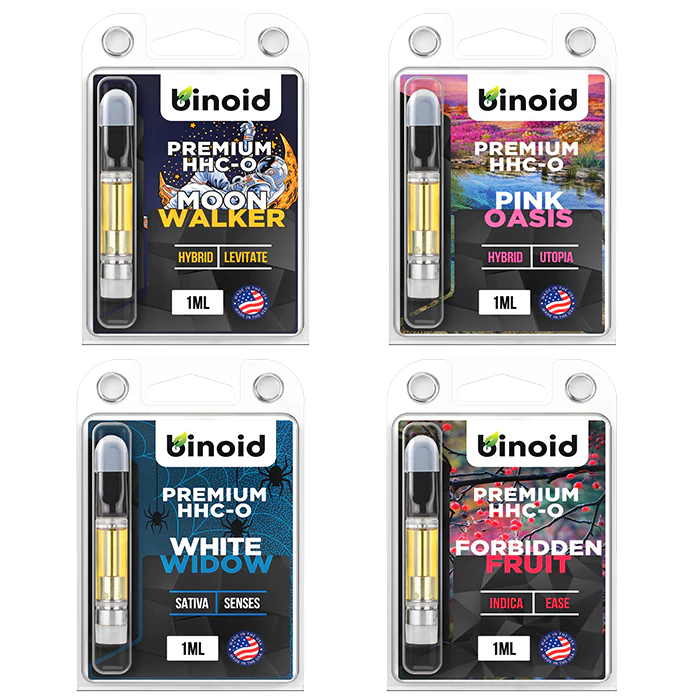
Binoid’s HHC-O Vape Cartridges contain the same pure, clean formula as all of their vaping products. These 1-gram cartridges contain a vape oil made simply with 92% premium HHC-O distillate and terpenes without any added ingredients whatsoever. The lab tests for these carts are easily accessible on their website, displaying how they’re potent, free of impurities, and fully compliant with federal law (2018 Farm Bill). As of now, they come in several strain options:

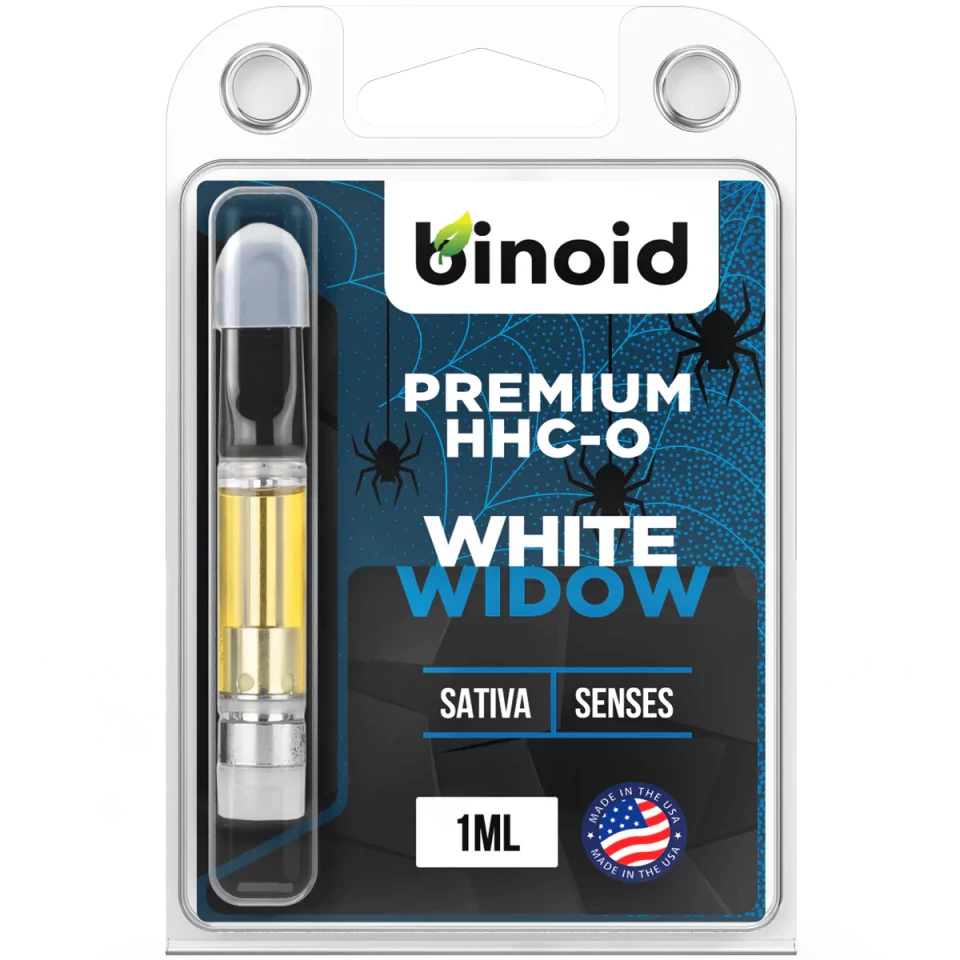
  • White Widow: 60/40 sativa-dominant hybrid with a citrusy, peppery flavor, capable of soothing the body while keeping you focused 
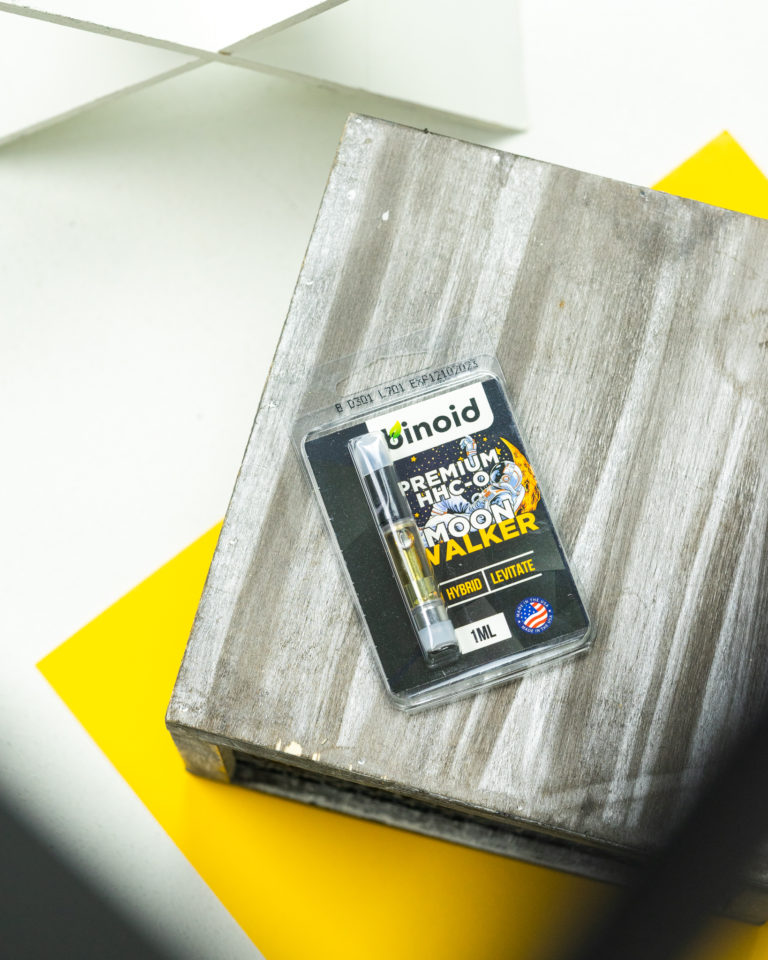
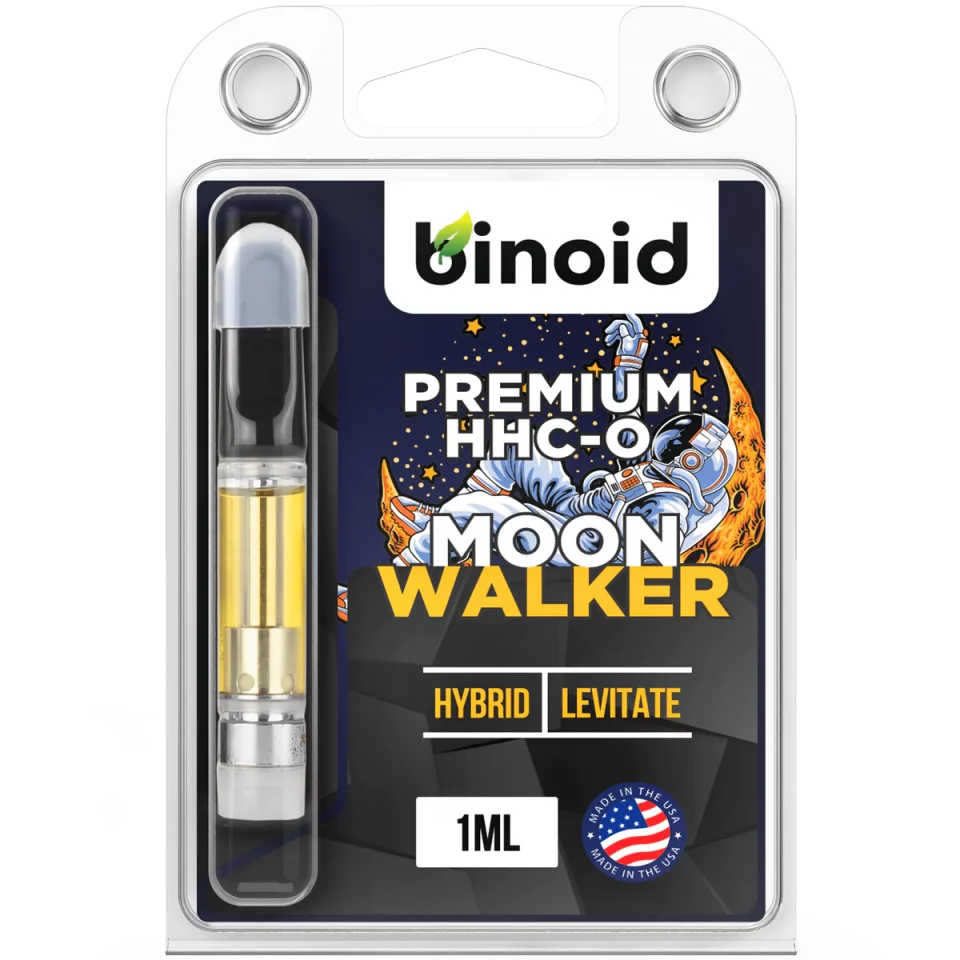
  • Moon Walker: 60/40 indica-dominant hybrid promising waves of euphoria and deep ease throughout the body, with a pine-like taste
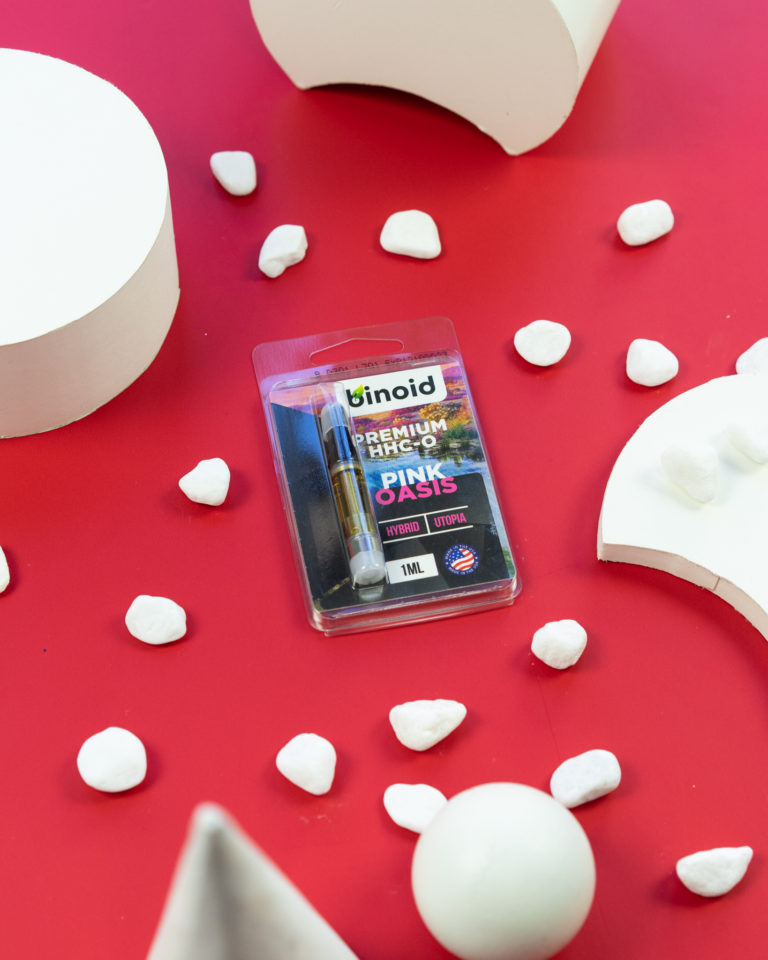
  • Pink Oasis: This hybrid strain makes you feel mellowed out in body and mind, with a delightful fruity flavor 
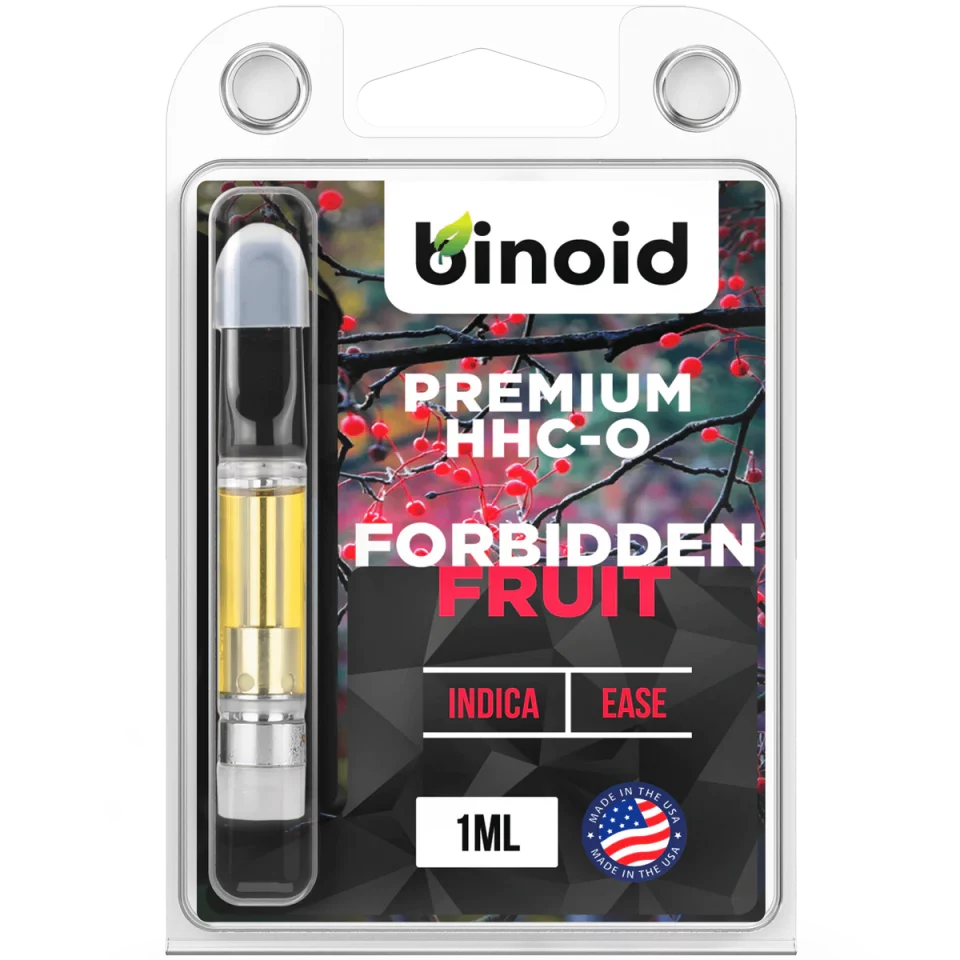
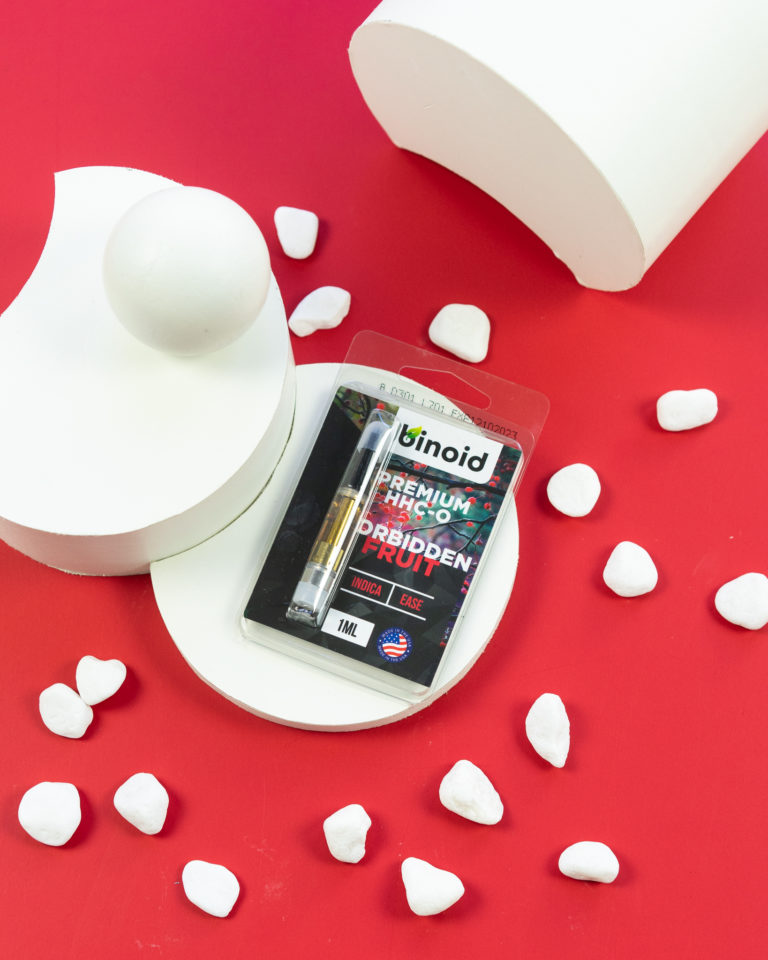
  • Forbidden Fruit: A 70% indica-dominant hybrid with lush notes of cherries and lemons, promising a powerfully hazy high complete with couchlock 
HHC-O
Courtesy of Binoid

What People Have To Say About Binoid’s HHC-O Vapes

Binod’s HHC-O Vape Cartridges have become hugely popular with the community of cannabinoid lovers, and you can find loads of positive reviews on the brand’s website. Many have found that HHC-O goes above and beyond a recreational cannabinoid, including:

Dani S. shared: “I’m disabled with PTSD and have awful anxiety. This helps me within a few minutes. I’ve tried all 4 varieties and the taste is spectacular! I’ll be reordering the 8 pack again.”  

Christina B. said: “I bought the Pink Oasis cartridge, and it really worked well with calming down my anxiety and depression, as well as helping me sleep and detach myself from overwhelming thoughts I’ve been having for a while. 🥺 I’m gonna try the Moonwalker one next~”
Other customers have been pleasantly surprised by its potency, like Craig H., who said, “Three hits and I’m in the zone.. I never write reviews but wanted to tell the skeptics that take it from an old dog, this stuff is legit. [S]eriously I am amazed at the quality… two thumbs up.”  

If you want to try the whole selection of Binoid’s HHC-O vape cartridges, you can get their cartridge bundle for an amazing price. 

Courtesy of Binoid

What Else Can HHC-O Do?

Glad you asked. HHC-O-acetate, as well as hexahydrocannabinol, are extremely new to the market. What this means is that there hasn’t been enough time for researchers to analyze these cannabinoids and discover their more clinical applications, which has been done with CBD, delta-9 THC and even delta-8 THC. Basically, we can’t reference any studies that go into the non-psychoactive effects of HHC-O.

However, people who have actually tried the cannabinoid have given us some insight. It’s not surprising that HHC-O, and HHC for that matter, seem to offer similar effects to delta-9 beyond their highs. A lot of people talk about the way in which HHC-O products help them with physical discomfort, appetite issues, nausea, mood imbalances, sleep and more. 

Again, everyone is different, and may experience the cannabinoid differently. But, the bottom line is that if you love what delta-9 THC has to offer, HHC-O is a great substitute.

HHC-O
Courtesy of Binoid

Legality and Drug Testing When Pertaining To HHC-O

HHC-O-acetate is a federally legal cannabinoid because federal law has made it clear that all hemp derivatives containing a maximum of 0.3% delta-9 THC are legal. Some states have banned certain psychoactive cannabinoids, or are in the process of doing so, so it’s always wise to check to see what your state’s legislation has to say about what’s legal and what’s not as far as hemp is concerned.

Another thing to keep in mind is that HHC-O may affect a drug test result. THC compounds like delta-9, delta-8 and THC-P are all metabolized by an enzyme known as THC-COOH. This enzyme is what urine tests are looking for. We don’t know yet whether or not HHC-O is processed by THC-COOH. But, many will agree that it’s better to be safe than sorry.

HHC-O
Courtesy of Binoid

Looking For a New Psychoactive Cannabinoid? Time To Finally Give HHC-O a Try!

HHC-O is a real game-changer on the cannabinoid market, offering a high that’s about as close to delta-9 THC as it gets, while being federally legal and readily available. If you’re a hemp enthusiast who loves the more psychoactive side of the plant, then you’re going to want to add this cannabinoid to your collection. 

At Binoid, you can get your hands on the cleanest, purest, and most effective HHC-O-acetate products possible in the form of fast-acting and 100% natural HHCO vape cartridges available in a selection of amazing strains, as well as HHC-O tinctures coming soon from Binoid.

The post What Is HHC-O: A Cannabinoid Guide appeared first on High Times.


source https://hightimes.com/sponsored/what-is-hhc-o-a-cannabinoid-guide/?utm_source=rss&utm_medium=rss&utm_campaign=what-is-hhc-o-a-cannabinoid-guide

Monday, March 28, 2022

Warrants Issued For Two Teens in Fatal Washington Dispensary Shooting

Warrants are out in Washington for a pair of teenaged boys allegedly involved in an armed robbery of a cannabis dispensary in the state that left an employee dead, as well as a number of other armed robberies in the area.

The Chronicle newspaper reports that Montrell Hatfield, 16, and Marshon Jones, 15, “are wanted in connection with a fatal shooting at a Tacoma marijuana dispensary and at least 10 armed robberies at pot shops in Pierce and King counties.”

On March 19, an employee at World of Weed in Tacoma, later identified as 29-year-old Jordan Brown, was fatally shot in the neck.

The Chronicle, citing court documents, reported that, during the incident, “Hatfield fought with an employee behind the cash register and Jones fatally shot the employee in the neck.”

“After ordering everybody to get on the ground, Hatfield allegedly fired a warning shot into the ceiling and approached the manager and other employees. He handed them garbage bags and ordered them to put all the money inside,” the newspaper reported. “Brown tossed the garbage bag back at Hatfield, put his hands in the air and stepped backward, records say. Hatfield and Brown then began fighting on the ground, according to witnesses and surveillance footage. Jones allegedly broke up the fight by shooting Brown in the neck. As the teens ran for the door, Jones told Hatfield ‘Don’t worry about them,’ records say.”

Prosecutors in Pierce County, Washington “have charged Hatfield with first-degree murder and second-degree unlawful possession of a firearm,” while “Jones has also been charged.” A “third man who acted as their lookout while they robbed the stores at gunpoint has not been identified,” according to The Chronicle.

The newspaper said that prosecutors “expect to file charges against the teens in the future for four marijuana dispensary robberies in Tacoma and one in Pierce County,” and that the teens are also “suspected in five similar robberies in King County.”

On the same day as the fatal robbery, Hatfield and Jones allegedly robbed a dispensary in Seattle, and tried unsuccessfully to rob another in Tacoma.

Armed robberies of cannabis dispensaries have risen at an alarming rate in Washington, which made history when it legalized recreational pot use for adults via a ballot initiative in 2012. Last week, citing data from the in-state trade group the Craft Cannabis Coalition, the Seattle Times reported that “there have been around 67 armed robberies so far in 2022,” up from 34 and 27 in 2021 and 2020 respectively.

The trend has prompted lawmakers and other officials in Washington to sound the alarm over the vulnerability of cannabis establishments, which typically have large amounts of cash on hand. Earlier this month, state treasurer Mike Pellicciotti traveled to Washington, D.C. to urge passage of the Secured and Fair Enforcement Banking (SAFE) Act, which would allow banks to provide financial services to cannabis businesses––something the federal prohibition on pot currently precludes them from doing.

“You rob the places where the cash is,” Pellicciotti said, as quoted by local television station KING5. “These robberies are tragic. But these robberies are also preventable.”

Last month, Republican state Sen. Jim Honeyford introduced a bill that would have added an extra year to the prison sentence of anyone convicted of first or second degree robbery of a cannabis shop, the same penalty that’s reserved for individuals who rob a pharmacy.

“When people would ask the infamous bank robber Willie Sutton why he robbed banks, Sutton simply replied, ‘Because that’s where the money is.’ Well, that’s why people rob marijuana retailers,” Honeyford said at the time. “Due to federal banking rules, these businesses are almost entirely cash-only operations, making them a target for robberies and a magnet for criminals.”

The post Warrants Issued For Two Teens in Fatal Washington Dispensary Shooting appeared first on High Times.


source https://hightimes.com/news/warrants-issued-for-two-teens-in-fatal-washington-dispensary-shooting/?utm_source=rss&utm_medium=rss&utm_campaign=warrants-issued-for-two-teens-in-fatal-washington-dispensary-shooting