Tuesday, September 28, 2021

New York Prison Being Transformed Into $150 Million Cannabis Campus

The site of a former state prison in New York’s Hudson Valley is being transformed into a $150 million “cannabis campus” by Green Thumb Industries, one of the nation’s largest producers of legal marijuana. The planned facility at the former penitentiary in Warwick, New York will produce tens of thousands of pounds of cannabis for the state’s upcoming, recreational marijuana economy, which was legalized by legislators earlier this year.

Until 10 years ago, the 38-acre plot of land purchased by Green Thumb Industries (GTI) was part of the Mid-Orange Correctional Facility, housing inmates sent to prison for marijuana offenses and other crimes. The institution dates back to 1914, when it was opened as a drug and alcohol treatment center known as the New York City Farm. 

In the 1930s, the facility was converted to the New York State Training School for Boys to house wayward youth from the city. In the 1970s, the location was changed to a prison for adult inmates before being shut down by Andrew Cuomo in 2011, the governor of New York at the time.

At a groundbreaking ceremony for the new cannabis production facility held earlier this month, GTI president Ben Kovler noted the significance of the new use for the site.

“The irony of building a cannabis facility near the grounds of what used to be a federal prison is not lost on us,” Kovler said. “Change is really in the air; change is happening in the country; change is happening here. And we’re able to go from a place where people used to be locked up for marijuana [to one] where we’re going to employ people and enable opportunity, create wealth and create a positive economic environment.”

New York
Shutterstock

New York Leaders See ‘A Brave New World’ in Cannabis

After the prison closed in 2011, local leaders began looking for ways to replace the 400 jobs the facility had provided the community. Warwick town supervisor Michael Sweeton set up a nonprofit development corporation and convinced the state to sell 150 acres of the property to the new entity for $4 million, which was paid with a loan from a local businessman. 

In 2018, the development corporation began selling plots of land, including a $526,000 sale of about eight acres to Citiva, a subsidiary of New York-based cannabis company iAnthus. Since then, a cannabis testing laboratory and a CBD products manufacturer have also opened facilities on the property.

GTI has invested $2.8 million for its 38-acre plot of land in a deal that included millions of dollars in tax incentives for the company. GTI plans to develop the property in three stages, creating 100 union jobs in the construction process. The first stage of construction will feature a $60 million cultivation facility spanning 200,000 square feet. Cannabis products manufacturing operations are also planned for the site, resulting in a facility worth an estimated $150 million. When completed, GTI’s cannabis campus will employ about 150 people earning salaries ranging from $50,000 to $100,000.

“Our fertile soil, educated workforce and close proximity to New York City sets us up to be the Silicon Valley for the cannabis industry,” state Sen. Michael Martucci said at the September 9 groundbreaking ceremony.

Town supervisor Sweeton said that the deal with GTI, which included property and sales tax breaks, would be a boon for the local economy.

“I think it’s just a home run for us,” Sweeton said. “We are a farm community economy—we have a lot of farm tourism, a lot of active farms, but we don’t really have much of the corporate realm. This is a brave new world.”

The post New York Prison Being Transformed Into $150 Million Cannabis Campus appeared first on High Times.


source https://hightimes.com/news/new-york-prison-being-transformed-into-150-million-cannabis-campus/


Monday, September 27, 2021

Fed Up With Pot Smoking, Burger Spot Bans All Unsupervised Patrons Under 18

The crew behind Garden Valley, California-based burger spot, Red Rooster Burgers & Brew, had enough with teens smoking pot in the bathroom, among other things, leading to a ban of all unsupervised customers under the age of 18.

“It is with GREAT sadness that we have made the decision to not permit underage kiddos in the restaurant without a parent or legal guardian for the following reasons…” Red Rooster Burgers & Brew posted on September 24. Red Rooster Burgers & Brew sells burgers, fries, shakes and ice cream sundaes, as well as alcoholic drinks such as beer or wine.

The post continued, adding a list of dozens of complaints—the first one on the list being “marijuana being smoked in the bathroom.” The list included littered condoms, skateboarding, the use and sale of e-cigarettes, as well as coins, fries and candy being thrown at employees.

With a brief review of California law, there is no possible way for people under the age of 18 to legally consume cannabis, unless it is for medical use and approved by a physician, under the supervision of a legal guardian.

“For the last two years we have spoken to kiddos and voiced our concerns numerous times!” the post continued. “Then, we implemented rules so they could still feel like they had a place to go, feel safe, and hang with their friends. It’s very clear to us that the bad behavior is not going to end. If you have a kiddo that needs a safe place to be after school please reach out to us. It is not our intent to exile the youth in our community but to protect our property. Some of their actions are unlawful and we won’t allow it.”

In California, only adults ages 21 and older can legally purchase pot for recreational purposes. There is no age limit on medical cannabis use, however minors under age 18 need permission from their legal guardians to use medical cannabis. So that means that young adults ages 18-20 are allowed to visit state-licensed medical dispensaries, but not adult-use dispensaries.

Unfortunately, pot smoking wasn’t the only problem at the burger restaurant, Red Rooster Burgers & Brew. “We also have issues with youth roaming the streets at night vandalizing the neighborhood,” the post continues. “Recently a neighbor’s Kalloween display was vandalized. We found pieces of it in our parking lot. It’s unfortunate but we will have to install security cameras to catch these vandals. We live in such a quaint beautiful town. I wish it didn’t have to be this way.”

Beyond the Burger: Teens and Pot

Sandwich chain Cheba Hut, makers of “Toasted” subs, took the exact opposite approach, marketing to young adults through sandwiches like “Thai Sticks” or “Kali Mist.” 

But most business owners don’t want a mess to clean up when teens take over. In August, Oregon-based Burgerville took an even more extreme measure and closed a franchise in Portland permanently, due to underage criminal activity.

The Centers for Disease Control and Prevention (CDC) strongly recommends against allowing teens to smoke pot, given the developmental changes in the brain. “Unlike adults, the teen brain is actively developing and often will not be fully developed until the mid 20s,” the CDC warns. “Marijuana use during this period may harm the developing teen brain.”

Those considerations from the CDC are apparently falling on deaf ears, however. A comprehensive study published two years ago in the American Journal of Public Health. looked at 1991-2017 American federal health data on more than 200,000 high school students, and found that the number of students who said they’d smoked pot at least once over the past month rose 10-fold, rising from 0.6 percent in 1991 to 6.3 percent by 2017.

The post Fed Up With Pot Smoking, Burger Spot Bans All Unsupervised Patrons Under 18 appeared first on High Times.


source https://hightimes.com/news/fed-up-with-pot-smoking-burger-spot-bans-all-unsupervised-patrons-under-18/

Federal Grant Approved to Study Medical Marijuana Impact in Arkansas

A federal grant will help fund a study on the medical cannabis program in Arkansas. 

Thanks to $1.3 million courtesy of the National Institute on Drug Abuse, which is part of the National Institutes of Health, researchers affiliated with the University of Arkansas for Medical Sciences (UAMS) and Arkansas Center for Health Improvement will conduct what is being described as “a first-of-its-kind population health analysis of the medical marijuana program, combining eligible consumers’ cannabis purchase information with insurance claims records and other data sources to gain a more comprehensive understanding of the effects of cannabis on consumers’ medical care.”

The study, titled “Population-Based Analyses of Healthcare Utilization and Outcomes in Users of Medical Marijuana,” will “also examine the impact of COVID-19 on the Arkansas medical marijuana program, including changes in cardholder requests, product purchases, healthcare utilization and adverse events,” according to a press release from the Arkansas Center for Health Improvement, which is “a nonpartisan, independent health policy center that serves as a catalyst for improving the health of all Arkansans through evidence-based research, public issue advocacy and collaborative program development.”

“This is an exciting and unique opportunity for not only our state, but also the country, to investigate the effectiveness of cannabis for therapeutic use,” said Dr. Joe Thompson, co-principal investigator on this study, and the president and CEO of the Arkansas Center for Health Improvement. “While researchers have gathered scientific evidence on the use of cannabis for the alleviation of symptoms such as pain and anxiety, there is little evidence on how the amount, strain, potency and method of use affect a person’s health experience.”

Additionally, the study will also “incorporate six Arkansas-based data sources, including the Arkansas Healthcare Transparency Initiative’s Arkansas All-Payer Claims Database (APCD), Arkansas Department of Health medical marijuana patient registry data, medical marijuana dispensary purchase data, vital records, emergency department records and Arkansas State Police motor vehicle crash data,” with all the data being “de-identified with linkages utilizing the unique capabilities of the Transparency Initiative.”

The Arkansas Center for Health Improvement said that by “examining data for Arkansans who have qualified for medicinal use, this research will help inform the potential role of cannabis in medical therapy.”

Voters in Arkansas approved a ballot measure legalizing medical cannabis in 2016. The state’s first dispensaries opened in 2019.

In December, state officials reported that patients in Arkansas had purchased $200.7 million and 30,648 pounds of medical marijuana.

That milestone represented a massive spike since April of last year, when the state reported $63 million and 10,050 pounds worth of medical cannabis sales, in the program’s first 11 months of existence. A month before that, the program passed the $50 million mark.

Arkansas is now one of nearly 40 states to have legalized medical cannabis as a treatment. According to the Arkansas Center for Health Improvement, as of this month, there are “more than 79,000 active Arkansas medical marijuana ID card holders who have one or more of the 18 approved medical conditions.” 

The state also boasts a little more than 30 licensed dispensaries and a total of five cultivators. 

According to the state’s Department of Health, patients with the following qualifying conditions are eligible for a medical cannabis prescription: cancer, glaucoma, positive status for human immunodeficiency virus/ acquired immune deficiency syndrome, hepatitis C, amyotrophic lateral sclerosis, Tourette’s syndrome, Crohn’s disease, ulcerative colitis, post-traumatic stress disorder, severe arthritis, fibromyalgia, Alzheimer’s disease, cachexia or wasting syndrome, peripheral neuropathy, intractable pain or pain that has not responded to ordinary medications, treatment or surgical measures for more than six months, severe nausea, seizures including without limitation those characteristic of epilepsy, severe and persistent muscle spasms including without limitation those characteristic of multiple sclerosis.

Any other medical condition or its treatment approved by the Department of Health is also eligible.

The post Federal Grant Approved to Study Medical Marijuana Impact in Arkansas appeared first on High Times.


source https://hightimes.com/news/federal-grant-approved-to-study-medical-marijuana-impact-in-arkansas/

Josiah Hesse on ‘Runner’s High,’ Athletics and Smashing the Stigma


When I heard my Denver writer colleague Josiah Hesse was releasing a major-deal book on cannabis and running, Runner’s High, I knew I had to chat about it with him for High Times. All writers have a struggle story, but Hesse’s is particularly powerful. Self-educated as an author, he independently put out his books and others through his previous job with Suspect Press in Denver.

When the magazine took a hiatus, and the world shut down, like many, Hesse was at a crossroads. But through the combined joy of toking up and working out, he was able to not only rediscover a love for running, but also come up with an idea for a major, groundbreaking book on cannabis. We caught up on how it all went down and the meaning behind the narrative.

Runner’s High Answers Burning Questions About Cannabis and Exercise

Runner's High
Courtesy of Josiah Hesse

Walk me through how the whole thing came to be, from the process of coming up with the idea and working on it to actually landing such big book deal, which we know is not easy.

I first got into running just for mental health reasons, to sort of improve some depression and anxiety symptoms. But I didn’t enjoy it all that much. I tried it later on with edibles around the time that legalization had hit Denver, and it was a very different experience for me. I felt lighter; I felt happier. There was less pain, less effort. It felt really good, and I started doing it all the time.

But, it was a while before I started meeting other runners and got into trail running and learned that cannabis is very popular with endurance runners, ultra marathon runners. And I thought that was interesting. It was so popular that I wrote an article about that for The Guardian, and the vast majority of professional athletes said they were using cannabis in their training and their recovery.

Additionally, I learned about the science behind the runner’s high, the sort of more sober, organic runner’s high, and it’s from endocannabinoids that exist in our brains, produced by our brains and bodies so that anyone who enjoys running, not just those who consume cannabis, but anyone, they’re experiencing a type of cannabis high.

So learning that these two things are sort of intrinsically linked really just piqued my curiosity for the subject. And you know when you’re a journalist and you get excited about a subject, typically, you’ve got a whole lot of other people working on that subject, but no one was covering it yet, so there was no competition for this beat, which was very exciting to learn that something was so prevalent with amateur athletes and with professional athletes, and yet so was so under-reported.

Me and my agent then crafted the proposal and went around to New York publishers. A lot of them thought it was a ridiculous idea and didn’t believe that anyone was using marijuana in conjunction with exercise. Some of them were even angry that the pitch landed on their desk. It really illustrated the difference between the East Coast, New York and the bubble that we live in in the West.

When we landed with Putnam, they were really excited about it, but they made a point to tell us, “This isn’t in our wheelhouse so we trust that you know what you’re talking about.”

Then things just kind of serendipitously came together when the story with Sha’Carri Richardson and the Olympics happened to drop just a couple months before the book came out, and it is something that a lot of people are talking about now and you see a lot of the cannabis industry. Now businesses are creating products designed for athletes and there are podcasts and publications on this, so it is becoming a part of the industry, and a part of the conversation in all avenues of sport. Just a few years ago, we were getting laughed out of meetings because people just thought this was a novelty book.

I’m so glad it’s taken more seriously now. How did having a background with DIY writing and publishing help when it came to writing for a big book deal?

I think what helped with Runner’s High in that regard was having written a couple of books and having gone through the marketing process from an artistic standpoint, being knowledgeable when it came to like actual, targeted marketing and strategic marketing wanted to make the marketing part of the creative experience. And so, you know, having written the books, and then gone through that, I had a sense of what I wanted and what I didn’t want for a book like this. It could so easily become a novelty book in the wrong hands.

What do you want people to take away when they read it?

That’s a great question, and there’s a lot of things that I hope Runner’s High achieves, like breaking the stigma about people who use cannabis and allowing professional athletes to be open about their cannabis use, allowing the cannabis industry to enter the world of sports in the form of sponsorships and endorsements and advertising. But I think the number-one thing that I want to emphasize with this book is that exercise does not have to suck.

I think that’s where a lot of Americans are at when it comes to exercise; they think of it as something that they have to get done. You know, the way I would think about like doing my taxes; I really hate doing my taxes; it’s a pain in the ass, and it causes me a lot of stress. I know for some people it’s fun, but I hate doing it, but I do it because it’s something I have to get done.

I think that’s the way a lot of people approach exercise, and they think of it from a cultural standpoint, like, “I’m not that kind of person who goes to the gym; I’m not an athlete.” There’s body dysmorphia; there’s pain; there’s all sorts of the barriers that people feel about exercise, both physically and psychologically, that I think cannabis has the power to help and change people’s relationship to their body and to the practice of exercise.

In terms of your own personal achievements, do you have any plans after the book for releasing another in your fiction series, or anything else you can share?

I would love to write Carnality Three, the third book in my fiction series. And I’d like to do a memoir because I really want to do just a straight piece of reporting about my childhood and my hometown. There’s lots of stuff I’d like to do. I want to write a biography of Pete Doherty. I think there’s always a lot of ideas; I I’ve never been short on ideas for projects, but there’s so many other factors.

The post Josiah Hesse on ‘Runner’s High,’ Athletics and Smashing the Stigma appeared first on High Times.


source https://hightimes.com/culture/josiah-hesse-on-runners-high-athletics-and-smashing-the-stigma/

New York Completes Appointing the Office of Cannabis Management

New York Governor Kathy Hochul last week announced appointments to a board that will help implement and enforce the state’s regulated cannabis industry.

On Wednesday, Hochul said that Reuben R. McDaniel, III and Jessica Garcia had been appointed to the Office of Cannabis Management, which will “create and implement a comprehensive regulatory framework for New York’s cannabis industry, including the production, licensing, packaging, marketing and sale of cannabis products” in conjunction with the Cannabis Control Board.

The appointments are a part of a rollout of the state’s new marijuana law that has moved at a glacial pace. In her announcement on Wednesday, Hochul, who became the Empire State’s first female governor late last month following the resignation of Andrew Cuomo, expressed frustration with the delays in the process.

“New York’s cannabis industry has stalled for far too long—I am making important appointments to set the Office of Cannabis Management up for success so they can hit the ground running,” Hochul said. “I am confident Mr. McDaniel and Ms. Garcia will serve the board with professionalism and experience as we lead our state forward in this new industry.”

New York is Catching Up

New York legalized pot use earlier this year, when Cuomo signed a bill into law in March after several previous attempts had failed to get off the ground.

The regulated weed market continues to be ironed out by New York policymakers, with the first dispensaries expected to open next year at the earliest. But the law did yield some immediate changes––namely, the ability to use marijuana freely, including in public wherever cigarette smoking is permitted. 

But as regulators continue to work out the rules for the market, some dispensaries have already opened on tribal lands in New York. 

On Thursday, the New York Times profiled some of those retail pot businesses, including dispensaries on the St. Regis Mohawk reservation that opened shortly after the state ended its prohibition on pot.

Although “New York City customers might prefer closer locales in Massachusetts (where recreational marijuana sales began in 2018),” the New York Times said, “the proprietors of the reservation’s new weed dispensaries say they are doing a steady business, capitalizing on delays from state leaders who have been slow to adopt regulations to govern the adult-use sale of the drug.”

“As such, the reservation’s dispensaries are seemingly getting a jump-start on what is projected to be a $4 billion industry in New York, as well as continuing a long tradition of using products like tobacco and gasoline—steady moneymakers for the tribe—to create jobs and income,” the report said.

Hochul’s appointments this week could be a shot in the arm for the sluggish rollout, with McDaniel and Garcia representing the final two appointments to the Office of Cannabis Management.

Earlier this month, Hochul announced that lawmakers had confirmed the appointment of Tremaine Wright as Chair of New York’s Cannabis Control Board (CCB) and Christopher Alexander as Executive Director of the Office of Cannabis Management (OCM).

The governor said at the time that one of her “top priorities is to finally get New York’s cannabis industry up and running—this has been long overdue, but we’re going to make up for lost time with the Senate confirmation of Tremaine Wright as Chair of the Cannabis Control Board and Christopher Alexander as Executive Director of the Office of Cannabis Management.”

“These two individuals bring a wealth of knowledge and experience to their new roles, and I know they will do a tremendous job of outlining and implementing regulations that are safe, fair and transparent and that recognize the need to remedy the impact that prohibition has had on communities of color. I look forward to working with them on building our state’s cannabis industry and affecting real change for New Yorkers,” Hochul said.

The post New York Completes Appointing the Office of Cannabis Management appeared first on High Times.


source https://hightimes.com/news/new-york-completes-appointing-the-office-of-cannabis-management/

Vapor Pressure Deficit is Real, People!

When we first brought up VPD (Vapor Pressure Deficit) a short while back we found that it was basically a new concept for a lot of people. Not just for home growers but even for industrial grow facility workers who are running large commercial indoor growing systems. It was clear that this topic needs to be spread to as many eyes and ears that grow as we all need to see and hear more about it.

VPD is as important as the nutrients you feed and the lights you place above your plants whether high intensity discharge lights like HPS bulbs or full spectrum LED grow lights. It’s true that plants eat photons and like a balanced diet of them (yes, you read that right—plants do eat photons!) but your environmental conditions needs to be on point for you to maximize your crop yields and overall plant health.

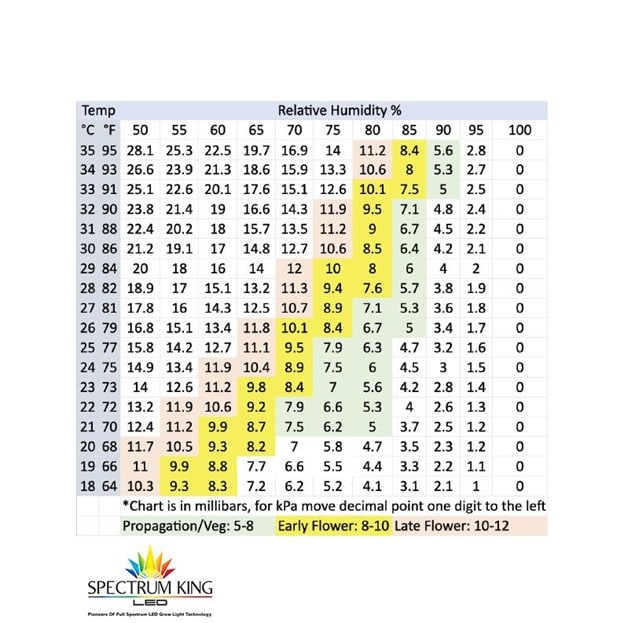
One of the biggest details that is overlooked is the placement of the probe that tracks the temperature and humidity in your grow site. Probes should be at plant canopy height and preferably towards the middle of your space and in larger industrial grow sites you should have multiple probes setup across your rooms so that you can see how balanced your rooms are. Should you see much higher temperatures here yet much cooler temperatures on the other side then you know that your room is out of balance. The same goes for humidity. Take a look at the chart below and see the sweet spots where you find temperature and humidity are in balance.

Having good air circulation will result in your temperature and humidity levels being more even and stable in your grow space. Get yourself a handheld laser thermometer and just walk around and take readings and note them down. You can find laser thermometers in many places these days and now they are very cost effective. They will make your life better and help you dial in your grow and fine tune it to get the performance you desire and crave.

Courtesy Spectrum King

By taking readings on top of the canopy, underneath it and in various spots around the room and noting them down you will see patterns. Adjusting fans, moving the probes, adding a humidifier and dehumidifier or several of each depending upon the size of your operation will help you fine tune that environment. One of the keys to knowing you have improved the space for your plants is that they will be eating more and the leaves will be “high-fiving the room”.

Nothing better than seeing plants at peak performance craving more to eat as that tells you that your hard work getting the environment dialed in is paying off. Knowing how to read and set up VPD so you can use this information as one of your main garden tools is very important and then to track it 24/7 from seed to harvest to ensure you have not missed anything along the way.

Data logging may sound nerdy and unnecessary but I assure you it is not. Having been to an industrial grow that was not monitoring conditions properly I can assure you that losing a whole room to root rot, botrytis (bud rot), and powdery mildew got their attention. They had data logging, probes, thermostats, humidistats… all of them but were not monitoring the data 24/7. As it turned out they had an improperly configured dehumidifier and it was getting up to 98% humidity every night in their grow rooms which means it was basically raining in there from condensation.

The crops were ruined for that cycle but if they had just checked the data every morning from the previous night’s readings they would have known instantly there was a problem and could have saved that whole huge room of buds. Having the tools to monitor VPD is great but knowing how to use these tools and checking in as close as real time as possible can have you correct an issue before it becomes a serious problem and have you capable of dialing in a room for a specific cultivar or a family of them  to where you can group plants together and know from the data that they will do well together.

VPD gives you a safe range to operate and push your plants in. That’s whether the lights are on or off as the temperature and humidity have to be balanced to keep conditions optimal for your crops. One of the things that can have people scratching their heads is that when the temperature goes down the humidity level goes up generally.

Moisture levels are kept in balance by your temperatures lights on and lights off combined with probe monitoring. If too damp trigger the dehumidifier, if too dry trigger the humidifier or exchange the air. Too drastic a temperature swing or humidity swing and you can have serious problems in your grow. Your temperature and humidity probes need to be properly located. Placing them on the wall near the door where they don’t get direct light and can be exposed to air currents and drafts from opening and closing of the door won’t get you accurate readings or good data. Having the right tools and knowing where to place them for best use is the key to getting your VPD on point.

The post Vapor Pressure Deficit is Real, People! appeared first on High Times.


source https://hightimes.com/sponsored/vapor-pressure-deficit-is-real-people/

Friday, September 24, 2021

Mississippi Lawmakers Move to Implement Medical Cannabis Legislation

After months of negotiating, lawmakers in Mississippi reached a deal this week to implement a new medical marijuana law in the state.

Mississippi Today reported that “legislative negotiators and leaders have agreed on a draft of medical marijuana legislation,” and that they are “anticipated to ask Governor Tate Reeves as early as Friday to call the Legislature into special session.”

The approach to Reeves could be significant, as the report noted that the first term Republican governor “has sole authority to call lawmakers into special session, and would set the date and parameters of a special session.”

“Although legislative leaders have expressed interest in dealing with COVID-19 and other issues in a special session, Reeves has appeared unwilling but said he would call a session for medical marijuana, pending lawmakers are in agreement and he agrees with the measure,” the report said. 

In May, Reeves said that a special session to address medical marijuana was “certainly a possibility.” 

For medical cannabis advocates and would-be patients of the treatment, the legislative wrangling has been a long, and at times frustrating, process.

Nearly 70 percent of Mississippi voters approved a ballot initiative last year that legalized medical marijuana for a host of qualifying conditions including cancer, epilepsy or other seizures, Parkinson’s disease, Huntington’s disease, muscular dystrophy, multiple sclerosis, cachexia (weakness and wasting due to chronic illness), post-traumatic stress disorder, HIV+, AIDS, chronic or debilitating pain, amyotrophic lateral sclerosis, or ALS, glaucoma, agitation from dementia, Crohn’s disease, ulcerative colitis, sickle-cell anemia and autism. 

Under Initiative 65, qualifying patients could legally possess up to 2.5 ounces of cannabis.

But the new law hit a major snag in May, when the state’s Supreme Court struck down Initiative 65 citing a strange and obscure provision in the state’s constitution. In the 6-3 ruling, the majority justices “ held the initiative had to be struck down because of an odd flaw in the state constitution’s voter initiative process,” NBC News reported at the time. 

“Passed in the 1990s, the measure called for a percentage of signatures to come from each of the state’s five congressional districts to get on the ballot,” NBC reported. “But, the judges noted, the state lost one of those congressional districts thanks to the 2000 U.S. Census, and now only has four districts.”

After that ruling, lawmakers in Mississippi went back to the drawing board to create a new medical marijuana program to supplant Initiative 65. 

Negotiations ran through the summer, with state lawmakers and other agencies hearing testimony from both advocates and opponents to medical cannabis. 

The breakthrough finally arrived on Thursday. Mississippi Today reported that some legislative leaders “released some details of the proposal—which had been kept close to the vest for months—such as that cities and counties will be allowed to ‘opt out’ of having medical marijuana cultivation or dispensaries, although local voters can override this.”

“City councils or aldermen, or county boards of supervisors, within 90 days of passage of legislation, could opt out from allowing cultivation or dispensing of medical marijuana within their borders,” the report explained. Voters in those cities and counties could force a referendum to rejoin the medical marijuana program if they gathered 1,500 signatures or 20 percent of the voters, according to the report.

Other notable provisions in the draft proposal include that smokable cannabis would be permitted, and that the state’s sales tax of seven percent would be imposed on medical marijuana. But the lawmakers have closed the door on personal cultivation, with Mississippi Today reporting that “outdoor growing would not be allowed, nor home growing.”

The post Mississippi Lawmakers Move to Implement Medical Cannabis Legislation appeared first on High Times.


source https://hightimes.com/news/mississippi-lawmakers-move-to-implement-medical-cannabis-legislation/